
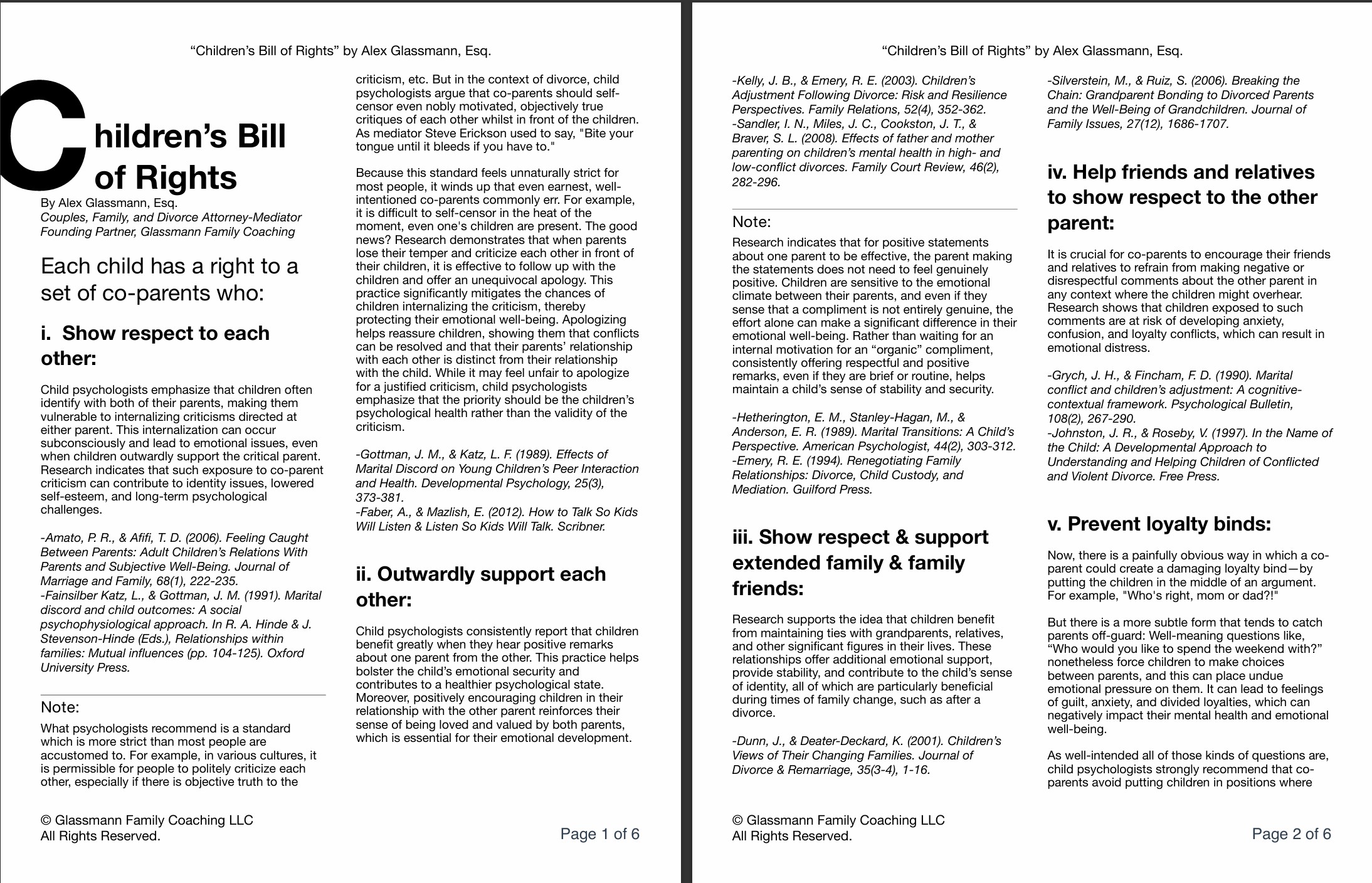
Children's Bill of Rights
more than just a set of rules—it’s a blueprint for creating stability in the midst of change
$50.00$25.00
This version of the Children’s Bill of Rights is a culmination of the better part of ten years of hands-on experience with hundreds of parents. The CRC’s original Bill of Rights provided a solid framework in terms of ideas, and now, my version introduces a more implementable, tested approach tailored to the complexities of modern co-parenting. It’s not just theory—it’s a collection of principles that have been put through the rigors of real-life application, adjusted, and refined to meet the needs of today's post-divorce families.
Clients and fellow mediators have embraced this updated Bill of Rights, finding it not only comprehensive but also adaptable to various family dynamics. The feedback has been overwhelmingly positive, with many appreciating how it balances the need for structure with the flexibility to address individual circumstances.
This version of the Children’s Bill of Rights is a culmination of the better part of ten years...
..of hands-on experience with hundreds of parents. The CRC’s original Bill of Rights provided a solid framework in terms of ideas, and now, my version introduces a more implementable, tested approach tailored to the complexities of modern co-parenting. It’s not just theory—it’s a collection of principles that have been put through the rigors of real-life application, adjusted, and refined to meet the needs of today's post-divorce families.
Clients and fellow mediators have embraced this updated Bill of Rights, finding it not only comprehensive but also adaptable to various family dynamics. The feedback has been overwhelmingly positive, with many appreciating how it balances the need for structure with the flexibility to address individual circumstances.
Why It Matters
Divorce can be one of the most disruptive and damaging experiences in a child’s life. Research shows that children of divorced parents are at a significantly higher risk of developing emotional and behavioral problems. They are twice as likely to drop out of high school, more likely to experience depression, anxiety, and other mental health issues, and are at a greater risk of experiencing long-term relationship difficulties as adults.[1][2]
Without the protection of a structured, thoughtful approach like the Children’s Bill of Rights, these risks can become all too real. Children exposed to high levels of parental conflict are more likely to suffer from chronic stress, which has been linked to irreversible changes in brain development, particularly in areas responsible for emotion regulation and executive functioning.[3] This chronic stress can manifest in difficulties with concentration, impulse control, and problem-solving, leading to poorer academic performance and an increased likelihood of engaging in risky behaviors.[4]
Moreover, children who lack consistent, loving relationships with both parents often struggle with issues of self-worth and attachment. These children are more prone to internalizing behaviors such as withdrawal, loneliness, and guilt, which can persist into adulthood, potentially leading to severe conditions like major depressive disorder and anxiety disorders.[5][6]
The psychological impact doesn’t stop there. Studies have shown that children of divorced parents are more likely to develop maladaptive views of relationships, leading to trust issues, difficulties in forming and maintaining relationships, and a higher likelihood of experiencing divorce themselves in the future.[7] This cycle of relational dysfunction is a clear testament to the far-reaching consequences that can arise when the principles of the Children’s Bill of Rights are not observed.
In short, ignoring these tenets doesn’t just risk temporary upheaval—it can result in lasting damage to a child’s emotional and psychological well-being. The Children’s Bill of Rights isn’t just a set of guidelines; it’s a critical safeguard against the potential lifelong harm that divorce can inflict on children.
Looking Ahead
As more families and professionals adopt this modernized Bill of Rights, the evidence increasingly supports its effectiveness in fostering environments where children of divorced parents can thrive, just as well as children whose parents are still married. Research consistently shows that when co-parents adhere to principles of consistency, open communication, and mutual respect—core tenets of the Children’s Bill of Rights—children can exhibit similar levels of emotional, behavioral, and academic well-being as their peers from intact families.[8][9]
Children raised in environments where these principles are applied experience fewer mental health challenges and demonstrate higher levels of resilience. Studies indicate that when children maintain strong, supportive relationships with both parents, and when parental conflict is minimized, they are less likely to experience anxiety, depression, or difficulties in school.[10] Furthermore, these children are more likely to develop healthy social skills and positive relationships in adulthood, breaking the cycle of dysfunction that can often follow high-conflict divorces.[11]
This modernized Bill of Rights is more than just a set of rules—it’s a blueprint for creating stability in the midst of change. It allows children to maintain a sense of normalcy and security, enabling them to grow up feeling loved and supported, regardless of their family structure. By implementing these principles, parents can ensure that their children not only survive but thrive in the wake of divorce, achieving outcomes comparable to those of children raised in married households.
Endnotes:
1. Kelly, J. B., & Emery, R. E. (2003). Children’s Adjustment Following Divorce: Risk and Resilience Perspectives. Family Relations, 52(4), 352-362.
2. Amato, P. R. (2000). The Consequences of Divorce for Adults and Children. Journal of Marriage and Family, 62(4), 1269-1287.
3. Lupien, S. J., McEwen, B. S., Gunnar, M. R., & Heim, C. (2009). Effects of Stress Throughout the Lifespan on the Brain, Behavior, and Cognition. Nature Reviews Neuroscience, 10(6), 434-445.
4. Hetherington, E. M., & Kelly, J. (2002). For Better or For Worse: Divorce Reconsidered. W.W. Norton & Company.
5. Emery, R. E. (2011). Renegotiating Family Relationships: Divorce, Child Custody, and Mediation. Guilford Press.
6. Sandler, I. N., Miles, J. C., Cookston, J. T., & Braver, S. L. (2008). Effects of Father and Mother Parenting on Children’s Mental Health in High- and Low-Conflict Divorces. Family Court Review, 46(2), 282-296.
7. Amato, P. R., & DeBoer, D. D. (2001). The Transmission of Marital Instability Across Generations: Relationship Skills or Commitment to Marriage?. Journal of Marriage and Family, 63(4), 1038-1051.
8. Kelly, J. B., & Emery, R. E. (2003). Children’s Adjustment Following Divorce: Risk and Resilience Perspectives. Family Relations, 52(4), 352-362.
9. Amato, P. R., & Keith, B. (1991). Parental Divorce and the Well-Being of Children: A Meta-Analysis. Psychological Bulletin, 110(1), 26-46.
10. Sandler, I. N., Tein, J. Y., Mehta, P., Wolchik, S., & Ayers, T. S. (2000). The Effects of the Family Bereavement Program to Reduce Mental Health Problems of Parentally Bereaved Children and Adolescents: A Randomized Controlled Trial. Journal of Consulting and Clinical Psychology, 68(5), 843-856.
11. Amato, P. R., & Cheadle, J. (2005). The Long Reach of Divorce: Divorce and Child Well-Being Across Three Generations. Journal of Marriage and Family, 67(1), 191-206.